
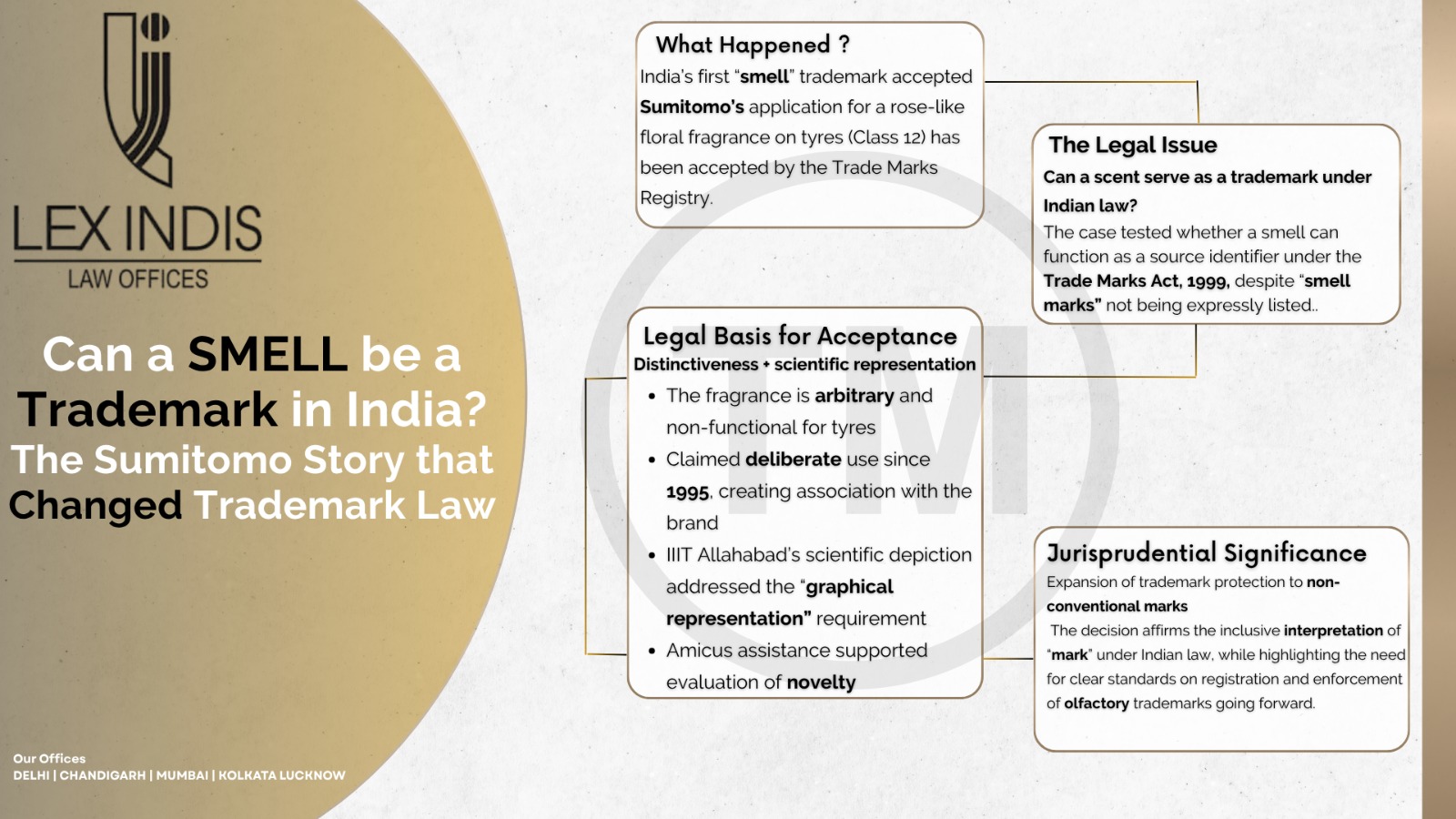
Traditionally, trademarks are understood as visible or audible signs such as brand names, logos, or sounds. However, the Indian Trade Marks Registry recently took a historic step by accepting India’s first-ever application for an olfactory (smell) trademark. This application was filed by Sumitomo Rubber Industries Ltd. for a “floral fragrance/smell reminiscent of roses as applied to tyres.” The case raised an important legal question: can a smell function as a trademark under Indian law?
Sumitomo argued that although a rose fragrance has no natural link with tyres, its long and exclusive use had made the smell uniquely associated with its products. The application initially faced objections for lack of distinctiveness and graphical representation. The Registry’s acceptance of the application marks a significant development in Indian trademark law.
Background
Trade Mark Application No. 5860303 was filed on 23 March 2023 in Class 12 (tyres for vehicles) on a “proposed to be used” basis. This was the first attempt to register a smell mark in India. Owing to the novelty of the issue, the Registry appointed Mr. Pravin Anand, Senior Advocate, as amicus curiae to assist in examining the legal and technical aspects of the application.
Submissions by the Applicant
The Applicant submitted that it had been deliberately adding a rose fragrance to its tyres since 1995 as part of its branding and product development strategy. Over time, this fragrance had become a source identifier, symbolising quality and innovation. The Applicant relied on international precedents, including the United Kingdom’s registration of a rose-scented tyre mark in 1996, as well as practices in the European Union, Australia, and the United States, where smell marks are recognised subject to strict conditions.
Submissions by the Amicus Curiae
The amicus curiae examined the two main legal requirements—distinctiveness and graphical representation. It was observed that while the Trade Marks Act, 1999, does not specifically mention smell marks, it also does not prohibit them. The rose fragrance applied to tyres was described as arbitrary and non-functional, and therefore capable of distinguishing the Applicant’s goods. The amicus also relied on a scientific graphical representation prepared by experts from IIIT Allahabad, which was said to meet statutory requirements.
Decision of the Trade Marks Registry
The Registry analysed Sections 2(1)(zb) and 2(1)(m) of the Trade Marks Act, 1999, and held that the inclusive definition of “mark” allows for non-conventional trademarks, including smells. It accepted the scientific representation prepared by IIIT Allahabad, which described the fragrance using seven olfactory dimensions. This representation was found to be clear, objective, and precise.
On distinctiveness, the Registry noted that a rose fragrance would clearly distinguish the Applicant’s tyres from the ordinary smell of rubber and help consumers identify their source. Accordingly, the application was accepted for registration.
Critical Observations
While this decision reflects a progressive approach, it raises practical concerns. The scientific method used for graphical representation may not be easily understood by consumers or enforcement authorities. Smell perception is subjective and can vary due to environmental factors, ageing of products, and individual sensory differences, making enforcement difficult. Further, granting exclusive rights over a commonly recognised natural scent may raise concerns about limiting the public domain.
Conclusion
The acceptance of India’s first olfactory trademark is a landmark moment in trademark law. However, it highlights the need for clear legislative or regulatory guidelines to ensure certainty, consistency, and fairness in the registration and enforcement of smell marks in the future.