
Indian weddings are synonymous with music, be it soulful sangeet melodies or high-energy DJ remixes that keep the dance floor alive. Music is not just an accessory; it is central to the celebration.
At the same time, songs and sound recordings are recognised as intellectual property and are protected under the Copyright Act, 1957 (“The Act”). As a general rule, the Act provides that communicating a copyrighted work to the public without a licence from the copyright owner amounts to infringement.
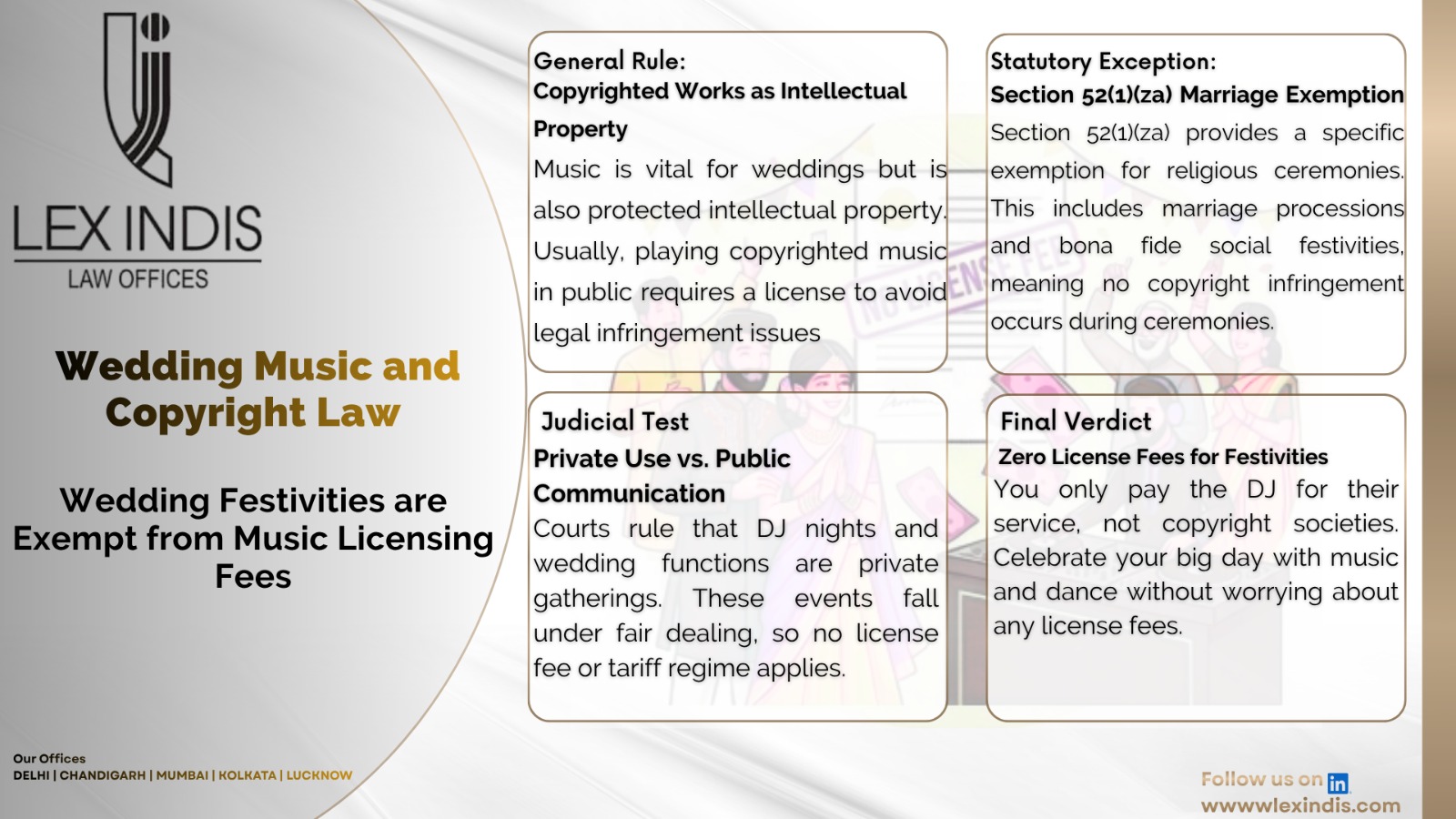
This naturally raises a crucial question: does playing music at a wedding ceremony qualify as “communication to the public”?
The answer lies within the Act itself. Section 52 carves out specific exceptions to infringement. In particular, Section 52(1)(za) clearly states that the communication of a work to the public in the course of any bona fide religious ceremony, including a marriage procession does not constitute copyright infringement.
However, the uncertainty often surfaces beyond the ceremonial rituals, especially during DJ nights and dance-floor celebrations, where remix versions of popular songs are played for family and friends. The debate then shifts to whether such use is public or private in nature.
Judicial interpretation resolves this ambiguity by applying the test of a private versus a public function. In the landmark judgment of Devendrakumar Ramchandra Dwivedi Vs. State of Gujarat, the Gujarat High Court held that the use of sound recordings during a marriage procession and its allied festivities amounts to private use. Such use falls within the scope of fair dealing under Section 52(1)(a)(i) of the Act, and therefore, no licence fee or tariff regime is applicable.
In conclusion, playing music during wedding celebrations—including DJ-led festivities—does not require a separate copyright licence. One only needs to pay the DJ, not the copyright society.
So go ahead, turn up the music, dance to your favourite remixes, and celebrate the big fat Indian wedding without legal worries.