
Introduction: –
In a significant ruling for personal liberty and procedural fairness, the High Court of Delhi, presided over by Hon’ble Dr. Justice Swarana Kanta Sharma, set aside a Trial Court order that had dismissed a bail application solely for being “too voluminous and bulky”. The judgment emphasizes that the length of a legal pleading cannot be a lawful justification by a Court for refusing adjudication on merits, particularly when the fundamental right to liberty is involved.
Brief Facts: –
The Petitioner was arrested for offences punishable under Section 65(2) of the Bharatiya Nyaya Sanhita, 2023, and Sections 6 and 21 of the Protection of Children from Sexual Offences Act, 2012. After his first bail application was dismissed, the Petitioner filed a second bail application alleging the violation of Article 22(1) of the Constitution of India, which necessitates communication of the grounds of arrest to the arrestee.
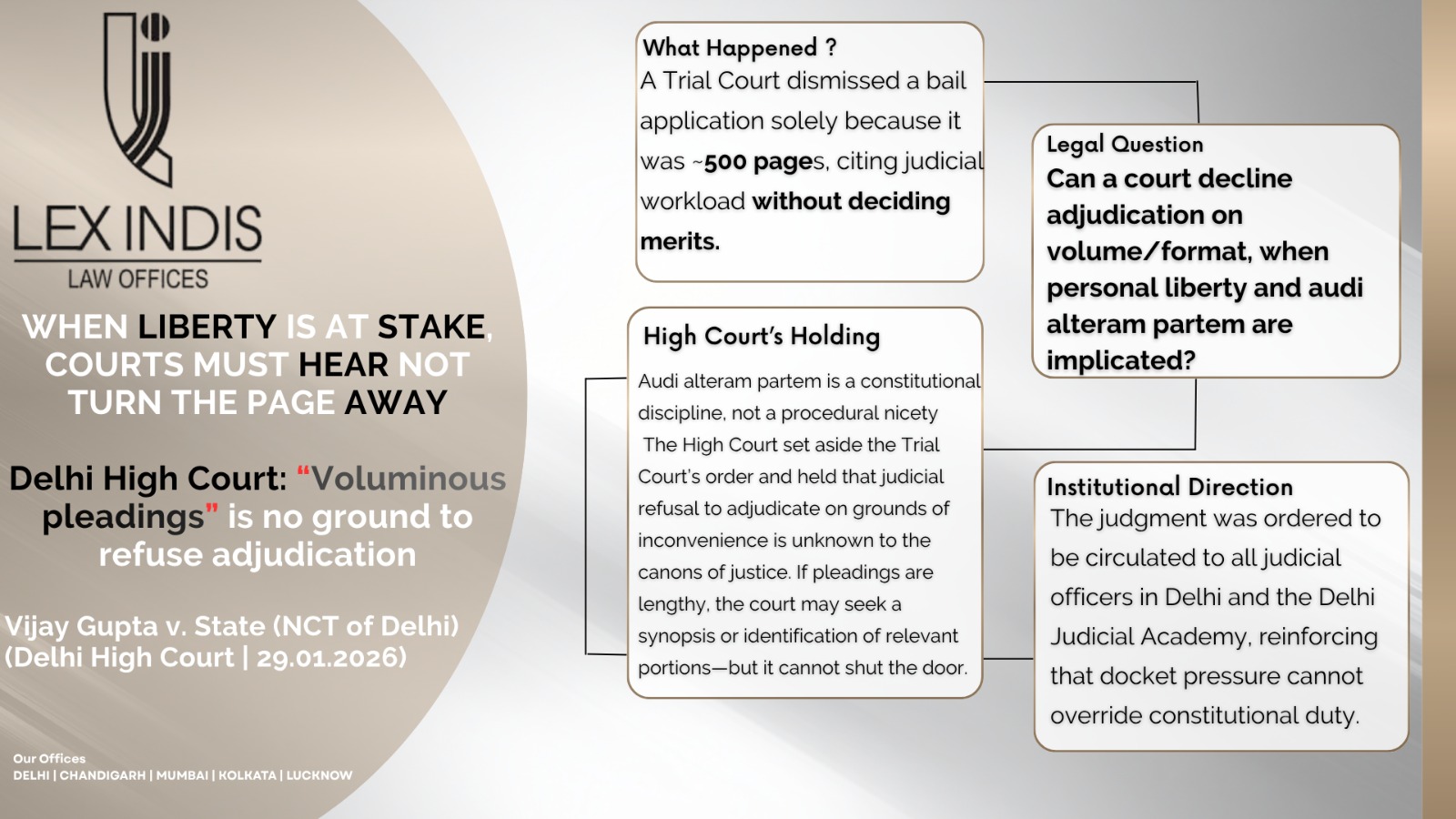
The Ld. Trial Court dismissed the bail application of the Petitioner not upon the merits of the case, but on the ground that the application ran into approximately 500 pages (including annexures) and that reviewing it would “consume precious judicial time” given the Court’s heavy burden of old cases. Further, the Petitioner was advised to file a fresh, concise application instead.
Questions before the Court: –
- Whether a bail application can be dismissed on technical grounds of being voluminous without an examination of merits?
- Whether such a dismissal violates the principle of audi alteram partem (the right to be heard)?
Findings of the Court: –
- The Hon’ble Delhi High Court set aside the decision of the Ld. Trial Court and directed the Ld. Trial Court to re-consider the bail application of the Petitioner on merits of the case. The Hon’ble Delhi High Court asserted that the liberty of an individual cannot hinge on the drafting style of a counsel or the workload of the presiding officer of a Court. Every pleading is “a voice seeking to be heard” and reading them is the very function for which judicial time exists. By dismissing the application solely on volume, the Trial Court failed to exercise its jurisdiction and ignored a vital constitutional plea regarding the legality of the arrest. Instead of outright dismissal, the Hon’ble Delhi High Court suggested that a Court could direct counsel to file a concise note, a written synopsis, or identify specific relevant paragraphs in voluminous case law.
Conclusion: –
The judgment emphasises that a judicial refusal to adjudicate because the Court finds it inconvenient to read the pleadings is unknown to the canons of justice. Moreover, to ensure this principle is upheld across the judicial fora of the State, the Hon’ble Delhi High Court ordered a copy of this judgment to be circulated among all judicial officers in Delhi and the Delhi Judicial Academy.